



In the manufacturing and processing of saw blades, induction brazing frames play a crucial role. As a supplier of Saw Blade Induction Brazing Frames, I often encounter questions from customers regarding various aspects of these frames, and one frequently asked question is whether the saw blade induction brazing frame requires special cooling equipment. In this blog, I will delve into this topic, analyzing the necessity of special cooling equipment based on the working principle, characteristics, and practical applications of saw blade induction brazing frames.
Understanding Saw Blade Induction Brazing Frames
Saw blade induction brazing frames are designed to join saw blade segments to the blade body using induction heating technology. Induction heating works by generating an alternating magnetic field that induces electrical currents (eddy currents) in the conductive materials, such as the saw blade segments and the blade body. These eddy currents generate heat due to the electrical resistance of the materials, reaching the brazing temperature and allowing the filler metal to melt and form a strong bond between the segments and the blade body.
The process of induction brazing offers several advantages, including precise control of the heating process, high efficiency, and the ability to braze complex shapes. However, it also generates a significant amount of heat, which can have various effects on the brazing frame and the saw blades being processed.
The Impact of Heat in Induction Brazing
During the induction brazing process, the heat generated can lead to several issues if not properly managed. Firstly, excessive heat can cause thermal expansion of the components in the brazing frame, leading to dimensional changes and potential misalignment. This can affect the accuracy of the brazing process and the quality of the final product. Secondly, high temperatures can degrade the performance of the electrical components in the brazing frame, such as the induction coils and the power supply, reducing their lifespan and increasing the risk of malfunctions.
Moreover, the heat can also have an impact on the saw blades themselves. Overheating can cause changes in the microstructure of the saw blade materials, leading to reduced hardness, strength, and wear resistance. This can result in premature failure of the saw blades during use, affecting their performance and durability.
The Role of Cooling in Saw Blade Induction Brazing
To address the issues caused by heat, cooling is an essential part of the saw blade induction brazing process. Cooling helps to maintain the temperature of the brazing frame and the saw blades within a suitable range, ensuring the stability and accuracy of the brazing process and the quality of the final product.
There are two main functions of cooling in saw blade induction brazing. Firstly, it helps to dissipate the heat generated during the induction heating process, preventing overheating of the brazing frame and the saw blades. Secondly, it can also help to control the cooling rate of the brazed joints, which is important for the formation of a strong and reliable bond between the saw blade segments and the blade body.

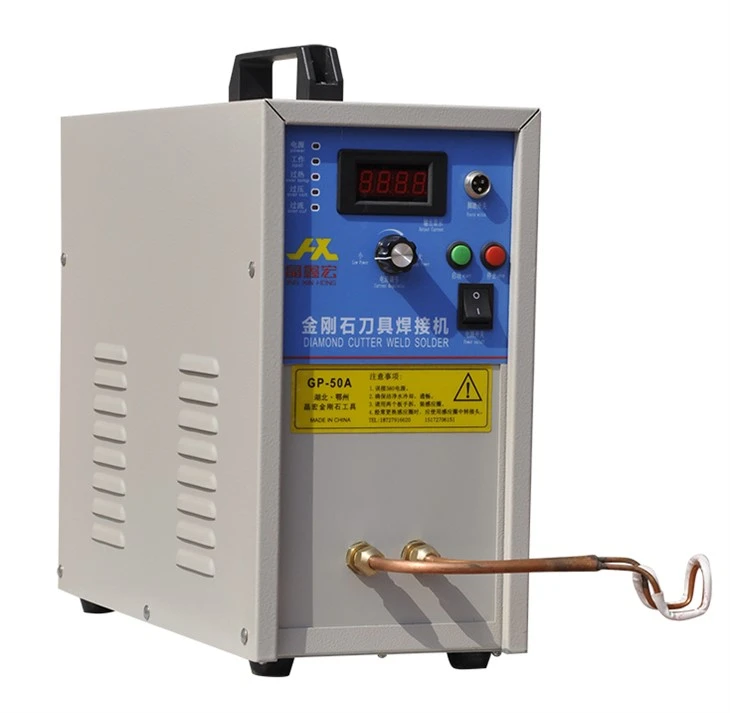
Types of Cooling Equipment for Saw Blade Induction Brazing Frames
When it comes to cooling equipment for saw blade induction brazing frames, there are several options available, each with its own advantages and disadvantages.
Air Cooling
Air cooling is the simplest and most cost - effective method of cooling. It involves using fans or blowers to circulate air around the brazing frame and the saw blades, dissipating the heat through convection. Air cooling is suitable for small - scale brazing operations or applications where the heat generation is relatively low.
However, air cooling has some limitations. It has a relatively low cooling efficiency compared to other methods, and it may not be able to effectively cool the brazing frame and the saw blades in high - power or continuous - operation scenarios. Additionally, air cooling can be affected by environmental factors such as temperature and humidity, which can reduce its effectiveness.
Water Cooling
Water cooling is a more efficient method of cooling compared to air cooling. It involves using water as a coolant to absorb and transfer the heat away from the brazing frame and the saw blades. Water cooling systems typically consist of a water pump, a heat exchanger, and a cooling tower or a chiller.
Water cooling offers several advantages. It has a high cooling capacity, allowing it to effectively dissipate large amounts of heat generated during the induction brazing process. It can also provide more precise temperature control, ensuring the stability of the brazing process. However, water cooling systems are more complex and expensive to install and maintain compared to air cooling systems. They also require a reliable water supply and proper water treatment to prevent corrosion and scaling.
Refrigerated Cooling
Refrigerated cooling is a specialized type of cooling that uses a refrigeration system to cool the coolant (usually water or a water - glycol mixture) to a very low temperature. This method is suitable for applications where extremely precise temperature control is required, such as brazing high - performance saw blades with strict quality requirements.
Refrigerated cooling systems can provide very accurate temperature control, ensuring that the brazing frame and the saw blades are maintained at a constant temperature throughout the brazing process. However, they are the most expensive option in terms of both initial investment and operating costs.
Does the Saw Blade Induction Brazing Frame Require Special Cooling Equipment?
The answer to this question depends on several factors, including the scale of the brazing operation, the power of the induction brazing system, and the quality requirements of the saw blades.
For small - scale operations or low - power brazing systems, air cooling may be sufficient to manage the heat generated during the induction brazing process. These systems typically have a lower heat output, and the relatively simple air cooling method can effectively dissipate the heat without causing significant issues.
However, for large - scale operations or high - power brazing systems, special cooling equipment such as water cooling or refrigerated cooling is usually required. These systems generate a large amount of heat, and air cooling may not be able to provide adequate cooling. Water cooling or refrigerated cooling can ensure that the brazing frame and the saw blades are maintained at a suitable temperature, preventing overheating and ensuring the quality and consistency of the brazing process.
In addition, if the saw blades being processed have strict quality requirements, such as high - precision diamond saw blades, special cooling equipment is also necessary. Precise temperature control is crucial for the brazing of these saw blades to ensure the formation of a strong and reliable bond between the segments and the blade body, as well as to maintain the performance and durability of the saw blades.
Our Products and Cooling Solutions
As a supplier of Saw Blade Induction Brazing Frames, we offer a range of products and cooling solutions to meet the different needs of our customers. Our Semi Automatic Brazing Machine is designed for medium - scale brazing operations, and it can be equipped with either air cooling or water cooling systems depending on the customer's requirements.
For customers who need to braze high - performance saw blades, our Diamond Saw Blades Segment Induction Heater and Making Diamond Segment Blade Brazing Machine are available with refrigerated cooling systems to ensure precise temperature control and high - quality brazing results.
Conclusion
In conclusion, the saw blade induction brazing frame may or may not require special cooling equipment, depending on the specific requirements of the brazing operation. While air cooling can be sufficient for some small - scale and low - power applications, water cooling or refrigerated cooling is often necessary for large - scale, high - power operations and applications with strict quality requirements.
As a professional supplier of Saw Blade Induction Brazing Frames, we understand the importance of proper cooling in the induction brazing process. We are committed to providing our customers with high - quality brazing frames and customized cooling solutions to ensure the efficiency, accuracy, and quality of their saw blade production.
If you are interested in our products or have any questions about saw blade induction brazing and cooling equipment, please feel free to contact us for more information and to discuss your specific needs. We look forward to working with you and helping you achieve the best results in your saw blade manufacturing process.
References
- ASM Handbook, Volume 6: Welding, Brazing, and Soldering, ASM International.
- Induction Heating Handbook, Second Edition, by Avram I. Kolomoets.
- Principles of Brazing, Edited by John C. Lippold and David E. Nissley.